1.前言
《手册》第 7 页 有一段关于 Java 变长参数的规约1 :
【强制】相同参数类型,相同业务含义,才可以使用 Java 的可变参数,避免使用
Object。说明:可变参数必须放置在参数列表的最后。(提倡同学们尽量不用可变参数编程)
正例:public List<User> listUsers(String type, Long... ids) {...}
那么我们要思考下面几个问题:
- 为什么要有变长参数?
- 可变参数的常见用法是什么?
- 可变参数有哪些诡异的表现?
本节将详细探讨这些问题。
2 变长参数的思考
2.1 初步了解可变参数
我们知道可变参数(vararg)方法(又叫 variable arity method)语言特性是在 Java 5 出现的。
可变参数方法接受 0 到多个相同类型参数(通常都是1个及以上)。
其核心原理是:创建一个数组,数组大小为可变参数传入的元素个数,最终将数组传递给方法。
2.2 可变参数的思考
我们学习 Java 一些语言特性时,最好能够思考它为什么会出现?是为了解决什么问题?有哪些优势?没有它会有哪些困难?等。
我们思考这样一个问题:可变参数的目的是什么?
试想一下,如果没有变长参数的语言特性,我们会怎么处理?
- 我们可以通过定义多个相同类型的参数进行重载。但是如果这样做如果参数数量不固定就无法实现。
- 我们还可以通过定义数组的参数进行重载。但是这就要求调用时要构造数组,又变成了 “定长”,而且需要增加构造数组的代码,代码不够简洁。
由此可见,变长参数适应了不定参数个数的情况,避免了手动构造数组,提高语言的简洁性和代码的灵活性。
3.常见变长参数函数
3.1 JDK中变长参数函数举例
包括 JDK 在内的很多库都封装了很多带有变长参数的函数。
java.lang.String#format(java.lang.String, java.lang.Object...) 就是JDK 中非常常见的变长参数函数之一。
其源码如下:
/**
* Returns a formatted string using the specified format string and
* arguments.
*
* <p> The locale always used is the one returned by {@link
* java.util.Locale#getDefault() Locale.getDefault()}.
*
* @param format
* A <a href="../util/Formatter.html#syntax">format string</a>
*
* @param args
* Arguments referenced by the format specifiers in the format
* string. If there are more arguments than format specifiers, the
* extra arguments are ignored. The number of arguments is
* variable and may be zero. The maximum number of arguments is
* limited by the maximum dimension of a Java array as defined by
* <cite>The Java™ Virtual Machine Specification</cite>.
* The behaviour on a
* {@code null} argument depends on the <a
* href="../util/Formatter.html#syntax">conversion</a>.
*
* @throws java.util.IllegalFormatException
* If a format string contains an illegal syntax, a format
* specifier that is incompatible with the given arguments,
* insufficient arguments given the format string, or other
* illegal conditions. For specification of all possible
* formatting errors, see the <a
* href="../util/Formatter.html#detail">Details</a> section of the
* formatter class specification.
*
* @return A formatted string
*
* @see java.util.Formatter
* @since 1.5
*/
public static String format(String format, Object... args) {
return new Formatter().format(format, args).toString();
}
根据参数名称或源码注释可知:第一个参数是格式定义,第二个参数为变长参数为前面的格式定义占位符对应的参数。
用法如下:
@Test
public void format() {
    String pattern = "我喜欢在 %s 上学习 %s";
    String arg0 = "https://www.imooc.com/";
    String arg1 = "编程";
    String format = String.format(pattern, arg0, arg1);

    String expected = "我喜欢在 " + arg0 + " 上学习 " + arg1;
    Assert.assertEquals(expected, format);
}
由于第二个参数为变长参数,我们只需要根据前面占位符的个数填充对应个数的参数即可,非常方便。
3.2 第三方库的可变参数函数举例
再如 commons-lang3 的字符串工具类 org.apache.commons.lang3.StringUtils#isAllEmpty函数源码:
/**
 * <p>Checks if all of the CharSequences are empty ("") or null.</p>
 *
 * <pre>
 * StringUtils.isAllEmpty(null)             = true
 * StringUtils.isAllEmpty(null, "")         = true
 * StringUtils.isAllEmpty(new String[] {})  = true
 * StringUtils.isAllEmpty(null, "foo")      = false
 * StringUtils.isAllEmpty("", "bar")        = false
 * StringUtils.isAllEmpty("bob", "")        = false
 * StringUtils.isAllEmpty("  bob  ", null)  = false
 * StringUtils.isAllEmpty(" ", "bar")       = false
 * StringUtils.isAllEmpty("foo", "bar")     = false
 * </pre>
 *
 * @param css  the CharSequences to check, may be null or empty
 * @return {@code true} if all of the CharSequences are empty or null
 * @since 3.6
 */
public static boolean isAllEmpty(final CharSequence... css) {
    if (ArrayUtils.isEmpty(css)) {
        return true;
    }
    for (final CharSequence cs : css) {
        if (isNotEmpty(cs)) {
            return false;
        }
    }
    return true;
}
该函数的功能是判断传入的参数(个数不固定)是否都是空字符串或 null。
用法非常简单:
@Test
public void isAllEmpty(){
    boolean result = StringUtils.isAllEmpty(null, "foo");
    Assert.assertFalse(result);
}
有了变长参数支持,我们不需要根据参数的数量构造定长数组或变长的集合,用法上更加简洁。
我们还看到org.apache.commons.lang3.StringUtils 工具类中还封装了
StringUtils#isEmpty 单个参数的判空函数。
通过函数命名和参数列表可以很容易地区分哪个是针对单参数,哪个是针对多参数(变长参数)。
这里也隐含了一个潜规则: 虽然变长参数支持 0 到多个参数,但是更多时候是用在 2 个参数及其以上的场景。
大家编写带变长参数函数时可以借鉴这种写法,即为单个参数和不定数量参数编写两个不同的函数。
如果大家平时使用三方工具包时能够留心看其源码,还会发现很多类似的变长参数函数。
4.可变参数诡异问题分析
通过上面的两个例子,我们了解了变长参数函数的优势。
接下来我们通过下面一个示例并结合 commons-lang 包的布尔工具类: org.apache.commons.lang3.BooleanUtils 来学习和分析可变参数导致的一个诡异问题。
示例代码:
public class BooleanDemo {

    public static void main(String[] args) {
        boolean result = and(true, true, true);
        System.out.println(result);
        justPrint(true);
    }

  // 函数1
    private static void justPrint(boolean b) {
        System.out.println(b);
    }

  // 函数2
    private static void justPrint(Boolean b) {
        System.out.println(b);
    }

  // 函数3
    private static boolean and(boolean... booleans) {
        System.out.println("boolean");
        for (boolean b : booleans) {
            if (!b) {
                return false;
            }
        }
        return true;
    }

 // 函数4
    private static boolean and(Boolean... booleans) {
        System.out.println("Boolean");
        for (Boolean b : booleans) {
            if (!b) {
                return false;
            }
        }
        return true;
    }
}
请问上面程序的结果是什么呢?
相信很多人会回答 true、true。
回答的依据应该是:示例中 main 函数调用的可变参数都是基本类型,因此和函数 3 最贴合,应该会选择函数 3 来执行。
实际是这样的吗?
将代码输入到 IDEA,就会发现 IDEA 就会给出下面这段提示:
Ambiguous method call. Both
and (boolean...)inBooleanDemoandand (Boolean...)inBooleanDemomatch.模糊的函数调用。该函数调用和
and (boolean...)和and (Boolean...)两个函数签名都匹配。
4.1 为啥会提示 ambiguous method call ?
很多人看到这里可能会毫无头绪,我们该怎么学习和分析这个问题呢?
按照我们的传统,我们从 JLS2中寻找答案。 我们发现其中 15.12.2 节 Compile - Time Step 2 : Determine Method Signature 中提到:
为了兼容Java SE 5.0 之前的版本,方法签名的选择分为 3 个阶段。
第一阶段:不让自动装箱和拆箱,也不能使用可变参数的情况下选择重载。如果无法选择合适地方法,则进入第二阶段。
由于不允许自动拆箱、拆箱和可变参数,这一条保证了Java SE 5.0 之前的函数调用的合法性。
如果在第一阶段可变参数生效,如果在一个已经声明了
m(Object)函数的类中声明m(Obejct...)函数,会导致即使有更适合的表达式(如m(null)) 也不会选择m(Object)。第二阶段:允许自动装箱和拆箱,但是仍然排除变长参数的重载。如果仍然无法选择合适的方法,则进入第三阶段。
这是为了保证,如果定义了定长参数的函数情况下,不会选择变长参数。
第三阶段:允许自动装箱、拆箱和变长参数的重载。
因此可见,在选择函数签名时,有以下几个阶段:
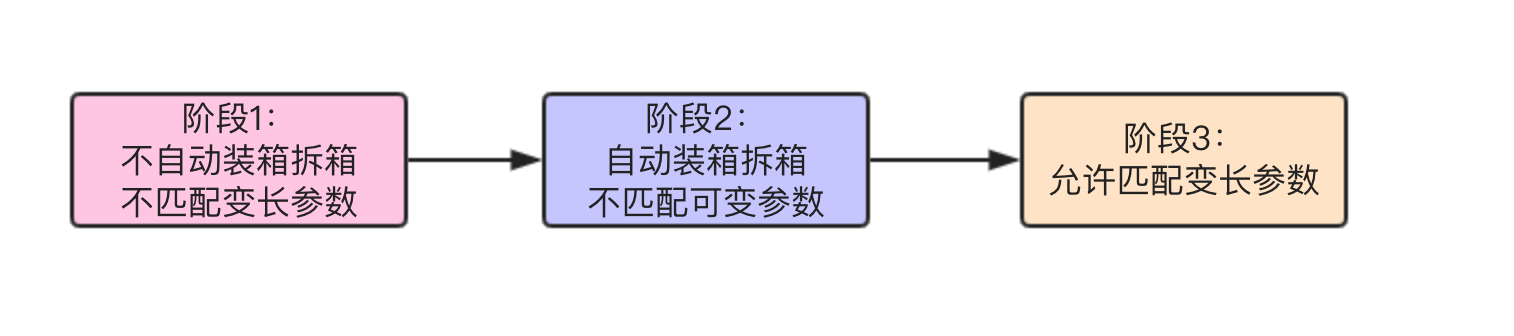
我们再回头看下示例代码。
第一阶段,选择了函数1。
第二阶段,允许自动装箱和拆箱,但是仍然不匹配可变参数的函数,仍然无法确认使用哪个 and函数,因为自动装箱仍然没有找到 3 个 boolean 参数的 and 函数。
第三阶段,允许自动装箱和拆箱,允许匹配变长参数。
问题就出现在第三个阶段,允许匹配变长参数时就要允许自动拆箱和装箱,这样函数 3 和函数 4 都可匹配到,因此无法通过编译。
4.2 变长参数的本质是什么?
4.2.1 反编译
我们对项目进行编译,来到 IDEA的 target 目录,查看编译后的 class 文件。
也可以直接用 javac BooleanDemo.java 对该类进行编译,然后通过前面介绍的 JD-GUI 反编译工具查看。
下面是反编译后的代码:
// 函数3
private static boolean and(boolean... booleans) {
        System.out.println("boolean");
        boolean[] var1 = booleans;
        int var2 = booleans.length;

        for(int var3 = 0; var3 < var2; ++var3) {
            boolean b = var1[var3];
            if (!b) {
                return false;
            }
        }

        return true;
    }

// 函数4
private static boolean and(Boolean... booleans) {
      System.out.println("Boolean");
      Boolean[] var1 = booleans;
      int var2 = booleans.length;

      for(int var3 = 0; var3 < var2; ++var3) {
          Boolean b = var1[var3];
          if (!b) {
              return false;
          }
      }

      return true;
}
我们可以清楚地看到,变长参数编译后内部通过数组来处理。
4.2.2 调试
我们还可以在函数 3 中打断点,来观察 booleans 这个参数对象的各种属性。
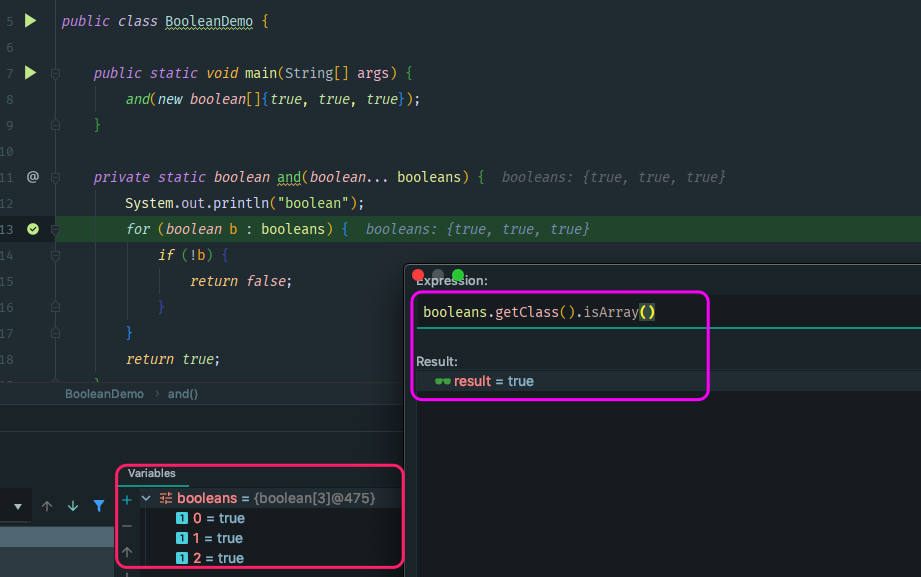
通过 “variables” 可预览到参数的类型和数据,可以看到 booleans 为 boolean 类型的数组,长度为 3。
我们还可以通过在 “variables” 选项卡的booleans 上右键,选择 “Evaluate Expression”, 然后通过调用 booleans.getClass().isArray() 来验证其是否为数组,查看其长度等。
未来有类似的场景,大家都可以通过断点调试来观察数据,还可以通过表达式来研究对象的一些属性。
更多高级的调试技巧请参考本专栏后续章节。
4.3 如何解决?
我们如果使用 commons-lang3 的 org.apache.commons.lang3.BooleanUtils 工具类中 and 函数,也会遇到类似的错误。
下面源码取自 commons-lang3 的 3.9版本。
<!-- https://mvnrepository.com/artifact/org.apache.commons/commons-lang3 -->
<dependency>
    <groupId>org.apache.commons</groupId>
    <artifactId>commons-lang3</artifactId>
    <version>3.9</version>
</dependency>
该类中有两个重载的变长参数函数:
org.apache.commons.lang3.BooleanUtils#and(boolean...)
 /**
     * <p>Performs an and on a set of booleans.</p>
     *
     * <pre>
     *   BooleanUtils.and(true, true)         = true
     *   BooleanUtils.and(false, false)       = false
     *   BooleanUtils.and(true, false)        = false
     *   BooleanUtils.and(true, true, false)  = false
     *   BooleanUtils.and(true, true, true)   = true
     * </pre>
     *
     * @param array  an array of {@code boolean}s
     * @return {@code true} if the and is successful.
     * @throws IllegalArgumentException if {@code array} is {@code null}
     * @throws IllegalArgumentException if {@code array} is empty.
     * @since 3.0.1
     */
    public static boolean and(final boolean... array) {
        // Validates input
        if (array == null) {
            throw new IllegalArgumentException("The Array must not be null");
        }
        if (array.length == 0) {
            throw new IllegalArgumentException("Array is empty");
        }
        for (final boolean element : array) {
            if (!element) {
                return false;
            }
        }
        return true;
    }
org.apache.commons.lang3.BooleanUtils#and(java.lang.Boolean...) 的源码和注释如下:
 /**
     * <p>Performs an and on an array of Booleans.</p>
     *
     * <pre>
     *   BooleanUtils.and(Boolean.TRUE, Boolean.TRUE)                 = Boolean.TRUE
     *   BooleanUtils.and(Boolean.FALSE, Boolean.FALSE)               = Boolean.FALSE
     *   BooleanUtils.and(Boolean.TRUE, Boolean.FALSE)                = Boolean.FALSE
     *   BooleanUtils.and(Boolean.TRUE, Boolean.TRUE, Boolean.TRUE)   = Boolean.TRUE
     *   BooleanUtils.and(Boolean.FALSE, Boolean.FALSE, Boolean.TRUE) = Boolean.FALSE
     *   BooleanUtils.and(Boolean.TRUE, Boolean.FALSE, Boolean.TRUE)  = Boolean.FALSE
     * </pre>
     *
     * @param array  an array of {@code Boolean}s
     * @return {@code true} if the and is successful.
     * @throws IllegalArgumentException if {@code array} is {@code null}
     * @throws IllegalArgumentException if {@code array} is empty.
     * @throws IllegalArgumentException if {@code array} contains a {@code null}
     * @since 3.0.1
     */
    public static Boolean and(final Boolean... array) {
        if (array == null) {
            throw new IllegalArgumentException("The Array must not be null");
        }
        if (array.length == 0) {
            throw new IllegalArgumentException("Array is empty");
        }
        try {
            final boolean[] primitive = ArrayUtils.toPrimitive(array);
            return and(primitive) ? Boolean.TRUE : Boolean.FALSE;
        } catch (final NullPointerException ex) {
            throw new IllegalArgumentException("The array must not contain any null elements");
        }
    }
错误的原因和前面的示例所分析的一致,都是在选择函数签名时,在前两个阶段没找到匹配的函数,允许变长参数匹配时,允许自动装箱和拆箱,却找到了两个可以匹配的函数。
我们如果直接参考两个工具函数注释上的例子,会发现编译无法通过。从这一点来看,如果注释中的用法和实际使用无法对应,会对使用者造成极大地困扰。
那么到底如何解决这个问题呢?
正如前面讲到的,我们可以看源码的单元测试,也可以通过 codota 来学习其他优秀的开源项目关于此函数的用法。
接下来我们实践一下。
4.3.1 查看源码的单元测试
我们拉取 commons-lang 源码,找到了 BooleanUtilsTest 关于 and 函数相关的单元测试代码。
org.apache.commons.lang3.BooleanUtilsTest#testAnd_primitive_validInput_2items
    @Test
    public void testAnd_primitive_validInput_2items() {
        assertTrue(
                BooleanUtils.and(new boolean[] { true, true }),
                "False result for (true, true)");

        assertTrue(
                ! BooleanUtils.and(new boolean[] { false, false }),
                "True result for (false, false)");

        assertTrue(
                ! BooleanUtils.and(new boolean[] { true, false }),
                "True result for (true, false)");

        assertTrue(
                ! BooleanUtils.and(new boolean[] { false, true }),
                "True result for (false, true)");
    }
// 省略其他
通过单元测试的代码,我们发现相关的测试代码的参数都是通过数组传入。
org.apache.commons.lang3.BooleanUtils#and(java.lang.Boolean...) 相关的单测亦然。
因此我们可以放弃“变长参数”的好处,“回归自然”,我们可以仿照类似写法,使用数组传参。
4.3.2 codota大法
我们在 codota 上找到该函数的相关范例,可以很好地解决本节所提到的问题。
第一个范例是自定义工具类来包装 org.apache.commons.lang3.BooleanUtils#and(boolean...) 函数:
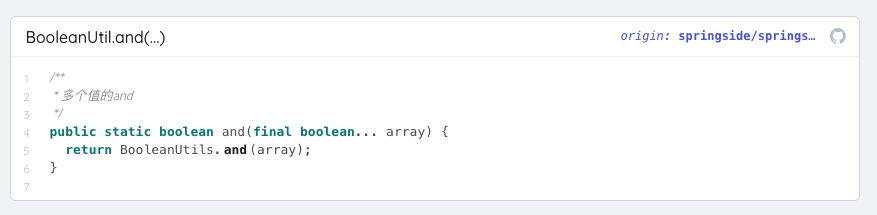
因为此工具类只包装了其中基本类型变长函数,如果传入基本类型的变长参数可以匹配,如果传入包装类型可以在第二阶段拆箱匹配到该工具函数。
第二个示例也是自定义工具类,但是参数是集合,实际使用时将集合转成数组再调用 org.apache.commons.lang3.BooleanUtils#and(java.lang.Boolean...)。

通过该示例我们发现作者是用集合来替代不定长参数解决此问题的。
注:通过 codota 我们还可以看到该工具类的其他函数的一些常见用法。
以上两种方法都是通过自定义工具类的包装,巧妙地避免了直接调用该工具类导致函数签名选择的冲突问题。
5.总结
本文主要介绍了变长参数的主要使用场景, 变长参数使用过程中的一个诡异问题,带着大家分析该问题背后的原因,并给出了解决该问题的方法。
希望大家遇到类似问题时,能够通过本文提供的方法来快速分析原因,并找到应对的办法。
下一节我们将讲述集合去重的正确姿势,会对不同去重方式的性能差异的原因进行分析,并对其性能进行对比。
课后练习
- 结合之前空指针章节所讲的内容,思考示例程序有啥隐患?该如何避免呢?
- 结合本节学的内容,请封装一个工具类,包装
org.apache.commons.lang3.BooleanUtils#or(java.lang.Boolean...)函数,避免选择函数签名时的冲突问题。